
Key Points
- A photon doesn’t know it, but humans have decided to call it a bunch of different things. One of the ways we label it is by saying that a photon’s energy level happens to fall within a “Band”.
- Band sizes and names are, to put it nicely, chaotic. They only make sense when you study engineering history. (And, even then, it’s not designed to help people.)
- Simple satellites from amateurs and universities tend to use VHF/UHF and perhaps S-Band frequencies. Military and science missions have relied heavily on S and X bands. And satellite TV systems like DirectTV use the C, Ka, and Ku bands. These aren’t firm rules since the military, for instance, can use whatever it wants!
- Many bands are filling up and governments around the world are struggling to provide licenses. If you want to launch a satellite, you need to make getting a license a high priority or you can be stuck on the ground waiting for paperwork.
Introduction
Spacecraft transmit and receive data using photons. Most satellites send and receive waves of photons using radios. Some satellites send pulses of photons with lasers, but that’s a different topic.
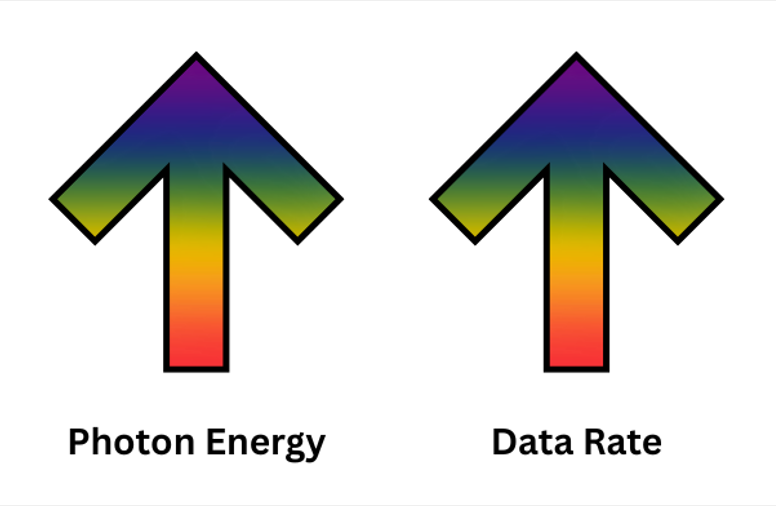
When radios send waves of photons out, they give them specific amounts of energy with a specific distribution of that energy across its transmission cone. The energy sets how quickly the photon flips its electromagnetic signature and that flip rate sets how much data it can send. However, more data isn’t always better because the faster you send data, the harder it can be to point the antennas at each other. (Antenna design is a critical part of the shape of the energy, too.)

You want to choose the band (photon energy) that gets you enough data to get the job done without adding too many requirements on pointing, power, and regulations.
In theory, you’d want to send as much data as possible, so you’d want to send really high energy photons, but you’d hit some problems:
- Everybody wants the same thing and photon waves of the same energy can mess each other up if they overlap.
- The atmosphere has electrons, atoms, and molecules that can eat up and/or bounce photons. Some energy levels are particularly valuable because they can make it all the way through the atmosphere with minimal loss.
- Really high energy photons usually have small antennas with small transmission cones. If you’re far away (like a satellite), you have to point precisely at the ground, which can be hard when you’re traveling thousands of meters per second.
To sort things out, governments make rules about who gets to send what photons. And to help people understand what they can ask for and can’t ask for, the energies are split up into sections that are called “Bands”.
Who’s Making the Rules
The short answer is that the International Telecommunications Union (ITU) sets the naming standards. However, each country has their own agency and it’s up to them if they follow the standards or not.
Note that you have to apply to each country’s agency to get a license to transmit. If you want to transmit to ground stations in 50 countries, you’re going to need a whole lot of paperwork filed. In the United States, it’s the Federal Communications Commission (FCC). In Japan, it’s the Ministry of Internal Affairs and Communications (MIC). In Europe, every country has its own group in addition to the European Union setting standards.
There are Two Band Levels
There’s one set of bands defined by the ITU that use cleanly defined boundaries. Then there are smaller bands that fall within and across the first set of bands that are defined by a variety of groups and users. Unfortunately, some of the labels in the first set of bands are also used in the second set, but can mean different things, depending on what you’re talking about. (Every communications engineer I’ve talked with agrees that it can be confusing but there’s little motivation to rename things at this point.)
The First Band
The ITU came up with a consistent way of separating frequencies. The table looks like this for the photon energies typically used for spacecraft.
The part of the ITU’s band definitions used most often on spacecraft
| Band Name | Abbreviation | ITU Band Number | Wavelength Range | Frequency Range |
| Very High Frequency | VHF | 8 | 1 m – 10 m | 30 – 300 MHz |
| Ultra High Frequency | UHF | 9 | 10 cm – 100 cm | 300 – 3,000 MHz |
| Super High Frequency | SHF | 10 | 1 cm – 10 cm | 3 – 30 GHz |
| Extremely High Frequency | EHF | 11 | 1 mm – 10 mm | 30 – 300 GHz |
| Tremendously High Frequency | THF | 12 | 0.1 mm – 1 mm | 300 – 3,000 GHz |
You can see that the bands are nicely broken up by the wavelength range, with each higher band number covering a power of ten. The frequency ranges start with “3” because you convert wavelength to frequency by dividing the speed of light (roughly 3*10^8) by the wavelength.
However, they muddied this clean separation a bit by using unhelpful names like “Extremely” and “Tremendously” high frequency. Like many things, the people who first developed things generations ago came up with names as they went along not having a master plan because they didn’t know what they didn’t know. For instance, leading up to World War II, a lot of stuff started in the low frequencies because those are the types of radios and radar systems that could be built. As electronics got better, they could go a little bit higher in photon energy. So they added “Very” because, “Wow! This is so much more energy!”. Then they got even higher and it was, “Wow! This is, like, ULTRA high frequency.” And so on. You can almost imagine their giddiness as they came up with new adjectives.
The Second Band
The ITU bands are great but relatively huge. For instance, the SHF band covers 3 – 30 GHz while most satellites will use a few tens of MHz or less. If you’re buying a $2 candy bar, it’s awkward to talk about its price in fractions of $30,000.
Plus, there are other reasons to want smaller bands. Water absorbs photons at some frequencies, as an example, so you want to bound that “pothole” in some way. And there are things to consider like the way some electronics are designed and even the way governments decide to manage photons within their borders. Reasons like these have led to there being dozens of smaller band names.
Of these smaller bands, there are a few primary bands that the majority of systems use:
UHF/VHF: Often used for amateur satellites and as an emergency backup. These are relatively low energy photons that can’t transmit much information but if you’re tumbling out of control, it’s easier to get a signal in or out.
S-Band/X-Band: These are the “normal” bands for scientific, military, and commercial space systems. They’re like an old truck… not super fast but fast enough and they’re reliable in just about all conditions. It’s getting harder to get a commercial license in the S-Band, in particular, as the military and science programs are prioritized
L, C, Ka, Ku, and V-Bands: These are “everything else”. They’re like sportscars… they’re fast but can be temperamental. Some need precise pointing. Others can be absorbed by water in the atmosphere. More satellites are using them, though, as technical capabilities have improved.
Table of satellite spectrum, as defined in the United States
| Band Name | Rough Frequency Range in the US | Comment |
| VHF | 136 -150 MHz Civilian240 – 270 MHz Military | Not the same as the ITU’s VHF 30-300 MHz band. Mostly used by amateurs and universities. |
| UHF | 400 – 470 MHz | Not the same as the ITU’s UHF 300 – 3,000 MHz band. Mostly used by amateurs and universities. |
| L-Band | 1 – 2 GHz | Used by navigation systems like GPS, Galileo, GLONASS, and BeiDou. Some weather satellites as well. |
| S-Band | 2 – 4 GHz | Science and military systems. Getting harder for commercial systems (and even NASA) to get spectrum here. |
| C-Band | 4 – 8 GHz | Broadcast TV, telecommunications |
| X-Band | 8 – 12 GHz | Many commercial and government systems. Sweet spot of data rate, signal quality, and ease of use. |
| Ku-Band | 12 – 18 GHz | Broadcast TV, Internet satellites, aviation and maritime |
| Ka-Band | 26 – 40 GHz | Mostly commercial telecom but some science missions and growing commercial use |
| V-Band | 40 – 75 GHz | Mostly telecom. Can be tricky and power hungry but demand for high data rates is pushing adoption. |
Curated Videos
- https://www.youtube.com/watch?v=LlvoL-l46aI
Highly recommended! He talks about satellite bands at the ITU band definition level and why you might choose to operate in one of the broad categories. - https://www.youtube.com/watch?v=aWJL1wH1lMs
It’s a bit of an advertisement, but they do a good job covering real world applications and how they listen to a lot of spectrum. - https://www.youtube.com/watch?v=A-H2NyDKU24
It’s kind of a funny mix between a charismatic guy talking to school kids and a serious engineer talking about bands in space. You can jump to just the 1:23 mark to get to the technical part.
Curated Links
- https://usradioguy.com/satellite-frequencies/
This is a great page to visit next, if you’d like more details. They break down bands into sub-bands and list the frequencies that satellites flying today are using. - https://www.orbitalfocus.uk/Frequencies/FrequenciesAll.php
This is another page that lists frequencies being used over the past few decades. - https://www.nasa.gov/smallsat-institute/sst-soa/soa-communications/
NASA’s SmallSat pages are a great read, no matter the topic. Their Communications section is another good example of their quality content. - https://www.esa.int/Applications/Connectivity_and_Secure_Communications/Satellite_frequency_bands
The ESA (European Space Agency) has a brief overview showing the bands that satellites operate on.