
Teacher Resources
Lots of people and organizations want to help teachers of all levels engage students with space. Finding them, though, can sometimes be challenging. On this page, we’ve gathered the projects we’re aware of. If you know of others, let us know! We’d love to help people find their community.
Table of Contents
Student Programs
These are resources that aim to provide end-to-end resources and directions for educators. Going with one of these programs will minimize the time you need to spend getting up to speed. Plus, students get access to professional mentors and may even get to fly their work in space.
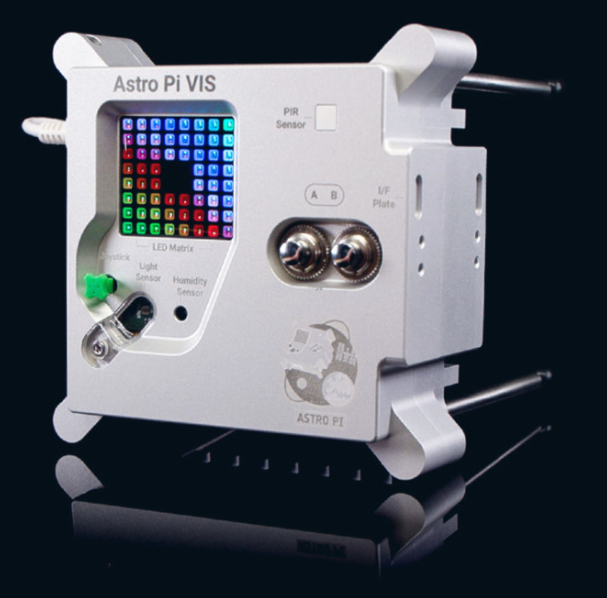
Astro Pi
Astro Pi is a collaboration between the Raspberry Pi Foundation and the European Space Union. Not only can you quickly build your own “CubeSat” using the same hardware that’s flying on the International Space Station, but you can upload your apps to space and get real data. Many students have been able to interact with the astronauts up there, too.
In fact, we love the platform so much that Space Steps uses the same hardware for the labs and apps we’re developing for classrooms. You can do both sets of labs and extend your investment in the hardware.

MaxIQ Space
MaxIQ Space offers courses and kits aimed at K-12 and university students. They’ve been working since 2016 and have a strong record with the communities they’ve served. Teams can get started for less than a couple hundred dollars with professional hardware, software, and lessons.
It’s particularly great that they offer materials at every price point and level. We’re not aware of any other organization that scales from simple, single-board experiments for elementary school kids to enabling university students to fly hardware on the International Space Station. And the recognition they’ve received shows that their passion is real.

NASA HUNCH
Something special about HUNCH is that they have an extensive catalog of programs and projects. Students can get involved with topics as diverse as sewing, food, and systems engineering in addition to hardware and software engineering. Each of the programs have NASA employees as mentors that provide feedback and help students understand how they’re helping and learning.
The HUNCH program is also special in that what the students produce often gets used by NASA directly, either on the ground or in space. Examples include stowage lockers, sleeping bag liners, and footpads. Their website advertises that more than 3,000 student produced items have flown to space.

Quest for Excellence
Quest for Excellence offers programs designed for students from elementary through high school. Like Astro Pi and NASA HUNCH, the projects students work on can be used on the ISS in real experiments. They also have non-space projects, such as an oceanic and robotic courses, each with hands-on activities. Mentors are assigned to each team so students will have opportunities to present their results and receive professional feedback.
They build their curriculum so that each level feeds into the next. The last course, where students can send their experiments to space for 30 days, takes up an entire academic school year. They’ll get exposure to not just the engineering but all the extra stuff around it like documentation and data analysis.
Open Source Satellite Programs
If you want to build and launch your own satellite, there are a few organizations that offer open source hardware and software you can start your own effort with. Building with these can save you years and perhaps hundreds of thousands of dollars.
Be warned, though, that launching your own satellite can still set you back hundreds of thousands of dollars in development, launch, and operations costs. And it will likely take multiple years, so this isn’t something an average high school class can tackle without a dedicated leader and mentorship team. But if you’re ready to take on those challenges, starting with one of these programs is worth considering.

OreSat
OreSat was started at Portland State University and has grown to include a number of institutions around Oregon. Their hard work has resulted in at least two satellites flying around in low Earth orbit.
They provide hardware & avionics schematics as well as software… it’s the complete package. You can also join their team instead of branching off. This may be a great option for educators looking to get their students to contribute to a space program without trying to do everything themselves.

LibreCube
LibreCube is a collection of hardware, electronics, and software that can be used for both space and ground-based systems. You can, in theory, build your own satellite and rover using the same key components.
They’re also 100% committed to open source, going so far as to only use open source tools when doing their engineering and analysis. On the other hand, they’re an independent organization not affiliated with a specific effort, so sometimes their documentation would benefit from your involvement. Consider building with their platform if you love the idea of jumping in and helping a truly passionate group trying to make flexible, low-cost platforms for the world.
AcubeSAT
AcubeSAT is a Greek organization working on an Open Source platform for biology research in space. Their GitLab page is filled with documentation, schematics, and notes. They don’t have a program you can follow but they invite you to use their materials to build your own project or to get involved with their program.
They are supported by SpaceDot, a Greek non-profit dedicated to supporting students who want to pursue space-based research. They sponsor a couple of programs, including a sophisticated 3U optical platform, but AcubeSAT is their open source effort. Their website is here: https://spacedot.gr/

PyCubed
PyCubed bills itself as an “Open-Source, radiation-tested CubeSat framework programmable entirely in Python”. They built on the popular CircuitPython platform, which can make it easier both to find compatible sensors and for students to learn to program with.
They do have a main webpage but, as of this writing, it seems their security certificate has expired. Additionally, their GitHub hasn’t been updated in a while. However, it’s very likely that the foundations are strong enough for you to build on. A lot of work has gone into the effort so if a Python-based development environment is intriguing to you, go ahead and check them out.

SatNOGS
SatNOGS isn’t a CubeSat program, it’s an open source way to communicate with your satellite. They’re an “Open Source global network of satellite ground-stations”. This is a tremendous time and cost saver for small satellite programs. Their value to you cannot be overstated.
You can also download data from other satellites and use it in classroom labs, build and contribute your own ground station, and get involved with their community. Educators may find that this is a great opportunity to get students involved with spacecraft operations.
Space-Focused Course Materials
These links take you to organizations focused on helping people understand “everything” about space, from design to operations. These communities are kind of like Space Steps, but they may have information we don’t or better serve you in some way. If you’re looking for free lessons or just the materials from which to make your own, check out some of these resources.
Note: There are a number of businesses that offer paid courses. Some of these may be awesome but we’re not able to review them so we’re not able to recommend them.

NASA Small Spacecraft Systems Virtual Institute
https://www.nasa.gov/smallsat-institute
This one resource may have everything you need as a student and/or educator. They’ve recently updated their website, too, so things are cleaner and easier to navigate.
In addition to world class resources, they also help you find funding, mentors, and even launch opportunities. And their page of space mission design tools is extensive, too. About the only thing we might caution against is that some of the friendly waters lead quickly to the deep end where expertise is needed so, if you’re starting from scratch, finding good mentors is key.
University of Hawaii Textbook
https://pressbooks-dev.oer.hawaii.edu/epet302/
A few years ago NASA sponsored the University of Hawaii’s development of a CubeSat platform as well as educational materials. The link above takes you to their extensive Open Source textbook developed with some of those funds. They use plain English and attempt to cover a wide variety of topics not typically seen in resources such as this, so it’s well worth a look.

EPFLx on edX
This is a free course that introduces many of the topics most critical to mission design. It focuses more on how orbital dynamics and propulsion work than it does about mechanical or electrical engineering, but our personal opinion is that this is a good thing for new people. You can learn about mechanical engineering anywhere, but learning about sun synchronous orbits from an astronaut for free in a structured course? Two thumbs way up.
Lunar Engineering 101
https://lsic.jhuapl.edu/Resources/Lunar-Engineering-101.php
The Lunar Surface Innovation Consortium (LSIC) is hosted by Johns Hopkins. They’re funded by NASA to organize groups, meetings, and content related to the United State’s return to the moon. They’ve got tons of great stuff you can participate in. The link above takes you to their videos and content related to getting started with lunar engineering and we encourage you to check out the rest of the site while you’re there. Super cool stuff.